Ratings
Ratings estimate playing strength from past games. Higher values suggest stronger expected results, but do not predict an individual game: a lower-rated player can beat a favorite.
The service uses Elo, considering opponents and game results. Beating a stronger opponent earns more than beating a weaker one. Even a draw can change ratings depending on opponent strength.
Rating reflects accumulated results; performance describes one tournament. Both calculations and their relationship are explained below.
A player’s rating categories
Each chess variant and time control has a separate rating. Rapid and Bullet results are not mixed. Chess960 does not change Standard ratings; Rapid does not change Blitz.
Supported variants are Standard, Chess960, Bughouse, Doubles 2x2 and Hand and Brain, each with Bullet, Blitz, Rapid and Classic categories. See Chess variants and Time controls.
If one event has games in different categories, each contributes to its own rating history. The first 10 games needed to remove ? must also be accumulated separately per variant and category.
Where ratings appear and what symbols mean
Ratings appear in club player lists, tournament tables and game cards. The following values are examples.
| Label | Meaning |
|---|---|
| — | No rating or other value is available in this cell. |
| 1520? | Provisional rating: calculated, but fewer than 10 eligible games. |
| 1520 | Established rating without the provisional marker. |
| Δ | Rating change for a game or tournament, depending on context. |
| +12 | Positive change: rating rose, or is projected to rise, by 12. May appear in parentheses beside the rating. |
| −8 | Negative change: a decrease of 8. |
Performance color compares the event performance with the starting rating:
- Green — above the starting rating.
- Red — below the starting rating.
- Normal text color — equal values or insufficient comparison data.
Club player lists show rating, peak and change for the selected variant and category. Change refers to the latest event in that category. Established players are listed above provisional and unrated players.
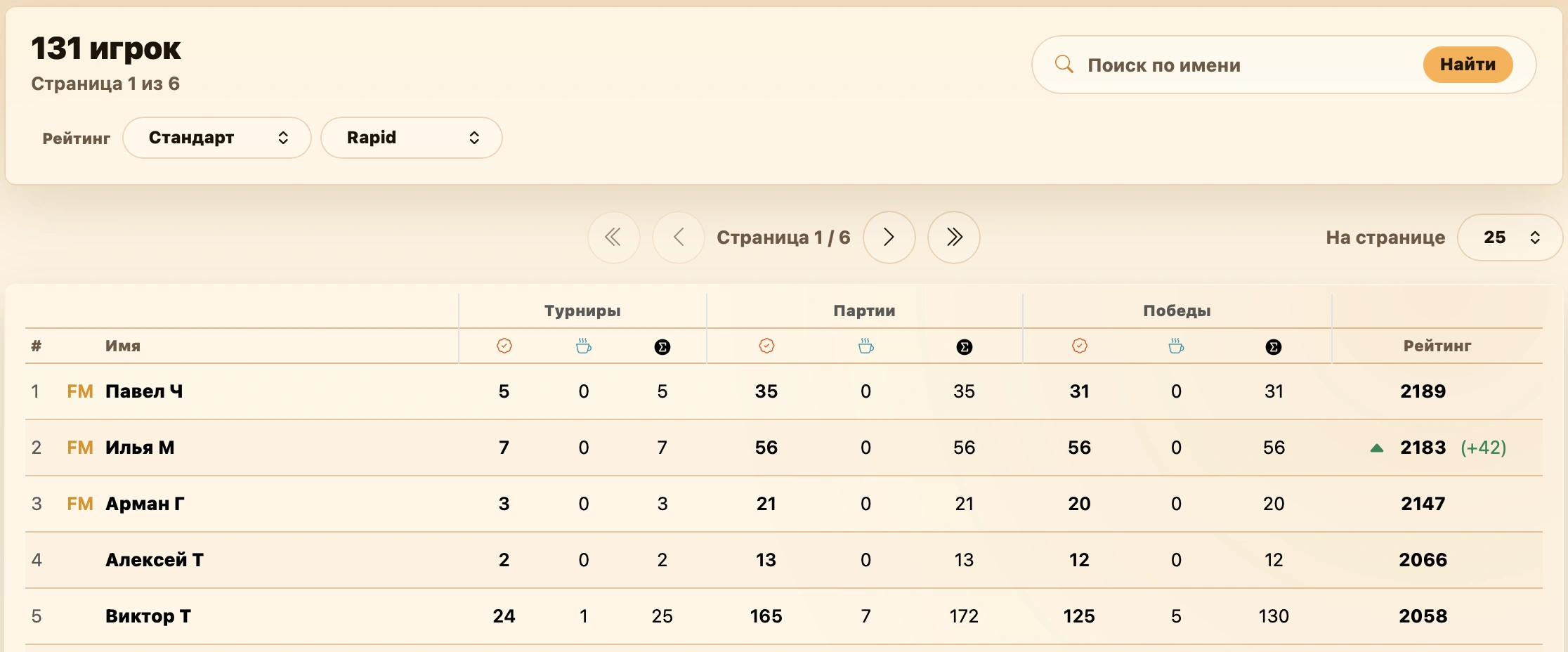
Tournament tables show whole-event change; game cards show the individual encounter. Before completion, these are provisional calculations.
The player-list header button How are ratings calculated? opens a short explanation. Detailed rules and examples follow.
Tournament tables let you compare starting rating, change and performance. See Tournament page for their location.
When ratings change
Ratings update after a rated tournament finishes. During play, tables and game cards show projected changes from entered results.
Before the first game. The service records each player’s starting rating.
During play. Each completed game contributes, for example +15 for a win or −9 for a loss.
At completion. Game changes are added and the player’s overall rating updates.
Ratings within a tournament
A player starting at 1500 with a projected +15 from game one still uses 1500, not 1515, for game two. Card changes describe contributions, not separate updates to the overall rating.
Which games count
Ratings measure play at the board, so opponents and actual results matter. An unplayed point, such as a BYE, says nothing about strength and does not change ratings.
The tournament and game must be rated, with a recorded result.
| Situation | Effect |
|---|---|
| Played rated game with a result | Counts according to rating and opponent-status rules. |
| No result yet | Does not count yet. |
| BYE — no opponent | No rating change and no addition to rated-game statistics. |
| Technical result | Technical wins, losses, draws and withdrawals do not count for ratings. |
| Deleted game | Excluded. |
| Friendly tournament | Does not change ratings, though performance may be calculated. |
Tournament points may include BYEs and technical results, so they can differ from the results used for ratings.
See Rated status and Entering a result.
Initial and provisional ratings
1. Before the first tournament: 0 without a question mark
Initially, 0 without ? means no strength estimate has been calculated, not weak play.
Registration alone does not create a rating. Play eligible games and wait for the tournament to finish.
2. Early games produce a provisional rating
After the first rated event finishes, the service calculates a value. With fewer than 10 eligible games, it carries ?, such as 1600?.
The question mark means the estimate is still developing. A few games cannot provide a complete picture, and a good or poor event may move it significantly. Future tournaments refine this provisional rating.
How the first value is calculated
The first rating comes from performance, based on opponent strength and the share of possible points scored.
Half the points against opponents averaging 1500 gives 1500 performance; against 1800, it gives 1800. More than half raises the estimate above the opponent average; less lowers it.
The starting point is game results → performance → initial rating. The service does not gradually add win points to zero; it replaces zero with a strength estimate.
For the initial rating, performance includes two virtual draws against 1800-rated opponents to smooth early results. Therefore displayed real-game performance and initial rating may differ.
Initial rating example
Example: a newcomer plays four games against established 1500 opponents and scores 2 points.
| Calculation | Results used | Value |
|---|---|---|
| Tournament performance | Four real games: 2/4, opponents average 1500. | 1500 |
| Initial rating | Those games plus two virtual draws: 3/6, opponent average (4 × 1500 + 2 × 1800) / 6 = 1600. | 1600? |
The counter remains 4 real games. Virtual results change the estimate but do not count toward 10 games.
Virtual draws exist only in initial-rating calculations: they are not played, do not appear in pairings and award no tournament or season points. See Tournament performance.
3. Later tournaments refine the estimate
Until 10 rated games accumulate, subsequent tournaments refine the provisional rating. Previous results remain: the prior estimate is combined with the new performance-based estimate using the same initial-rating rules. Estimates supported by more games carry more weight.
Combining two tournaments
Example: four games produced 1540?. Six more games produce an estimate of 1640 including the two virtual draws. The second event carries more weight because it has more real games. The combined value is closer to 1640:
(1540 × 4 + 1640 × 6) / 10 = 1600.
With 10 games total, 1600 is saved as established. Equal game counts would give both estimates equal weight.
In general: multiply each estimate by its real eligible game count, add, then divide by total real games. Round to an integer.
When virtual draws are added
Two virtual draws are added for every event started with a provisional rating, including the first and the event that reaches 10 games. Events subsequently started with an established rating do not use them.
Only real games determine weights: 4 and 6, not 6 and 8. Virtual draws have already affected the estimates but do not increase counts.
4. The question mark disappears after 10 eligible games
After tournament completion, 10 or more eligible rated games produce a rating without ?, called established here. Later results use ordinary Elo gains and losses.
If you entered with 8 games, the tenth may occur in round two, but ? remains until completion. The whole event uses initial-rating rules; afterward the updated value is saved without ?.
If the first event already includes at least 10 eligible games, the initial rating appears without a question mark.
1540 and 1600 are illustrative. Actual values depend on results and opponents.
Opponents with provisional ratings
A ? opponent may be much stronger or weaker than their current estimate. Individual games against them do not yet increase or decrease an established opponent’s rating.
Normal Elo changes require both players to start the tournament with established ratings. This also applies to separate boards in team matches.
| Pairing | What happens |
|---|---|
| Both established | Elo changes are calculated for both. |
| One provisional or unrated | Game Elo change is zero for both. The result contributes to the newcomer’s initial estimate. |
| Both provisional or unrated | Normal Elo change is zero; results contribute to both initial estimates. |
You are 1600 and your opponent 1450?. A win gives no Elo gain and a loss no deduction. The result refines their initial rating and counts toward eligible games and performance for both.
Performance still needs an opponent estimate. Very new players use 1500; after at least 5 games, their own value is used even with ?:
| Opponent experience at start | Value used |
|---|---|
| Fewer than 5 eligible games | Default 1500. |
| At least 5 eligible games | Recorded rating, including provisional. |
An opponent with 7 games and 1450? contributes 1450 to performance, but still produces no normal Elo change. Once established, future events use normal rules.
Team-opponent calculations are described below.
Calculating Elo changes
For established players, the service compares actual game results with rating-based expectations.
Equal opponents are expected to split points: a draw meets expectations, a win raises rating and a loss lowers it. A draw against a stronger opponent may gain points; against a weaker one it may lose points.
The size also depends on rating history through the K-factor, explained below. First, examples.
Against an equal opponent
Both players have established 1500 ratings. Assume K = 30.
After one such game: 1515.
Rating remains 1500.
After one such game: 1485.
Each game contributes separately. Changes of +15, −9 and +4 total +10, taking 1500 to 1510.
One loss therefore need not mean a negative tournament total; other results may outweigh it.
Effect of opponent strength
Keep your rating at 1500 and K = 30, changing only the established opponent’s rating.
| Opponent | Win | Draw | Loss |
|---|---|---|---|
| 1400 — lower rated | +11 | −4 | −19 |
| 1500 — equal | +15 | 0 | −15 |
| 1600 — higher rated | +19 | +4 | −11 |
Beating the stronger opponent gives +19, versus +11 for the weaker. Drawing with 1600 gives +4, while drawing with 1400 gives −4.
Equal win counts can therefore produce different gains because opponents differ.
Why changes differ: the K-factor
K controls sensitivity to new results. Larger K makes each win or loss move the rating more.
Early estimates change faster; a longer history responds more cautiously. Beating an equal opponent gives +15 at K = 30, but +10 at K = 20.
K depends on eligible game count and the highest established rating reached, the peak:
| Experience and peak | K |
|---|---|
| Up to and including 10 eligible games | 40. Below 10 the rating is provisional; at exactly 10 it is established with K = 40. |
| 11–39 games, peak < 2200 | 30. |
| 40+ games, peak < 2200 | 20. |
| 11+ games, peak ≥ 2200 | 10. No need to reach 40 games. |
All games in an event use its starting K. Thresholds crossed during play affect later events.
A reduced K does not increase again on recalculation. Dropping below 2200 does not erase the historical peak.
Opponents can have different K values, so one may gain 15 while the other loses 10. Rating points are not transferred in a fixed quantity.
Formula for checking the calculation
First determine the expected score: the share of points expected over many games against that strength. 0.5 means half the points, not a guaranteed draw.
Equal ratings expect 0.50. A 1500 player against 1400 expects 0.64, and against 1600 0.36. These come from a rating-difference table.
Then apply:
Rating change = K × (game score − expected score).
Win = 1, draw = 0.5, loss = 0. A 1500 player drawing against 1600 at K = 30:
30 × (0.5 − 0.36) = 4.2 → +4 points.
Each game change is rounded before summing, so it can differ slightly from rounding the total once.
Expected-score rating differences are capped at 400. For 1500, opponents at 1900 and 2100 yield the same expectation. Table intervals also mean small opponent-rating changes may leave the game change unchanged.
Tournament performance
Performance estimates the level of this particular tournament, using results and opponent strength.
Half the points against opponents averaging 1600 gives 1600 performance. More than half raises it; less lowers it.
Thus 3/6 against strong opponents and 3/6 against beginners produce different performance ratings.
Why performance does not become the new rating
Rating incorporates history and changes gradually; performance describes one event. A great performance does not immediately move an established rating to that level.
Performance 1600, new rating 1508
Example: established 1500, K = 30, two games against 1600 opponents: one win and one loss.
| Measure | Result |
|---|---|
| Performance | Half the points against 1600 opponents gives 1600. |
| Rating change | +19 for the win and −11 for the loss: +8 total. |
| New rating | 1508 after completion. |
Both are correct: 1600 describes the event, 1508 the updated historical estimate.
Performance color compares with starting rating: green above, red below. See symbols.
Results used for performance
The service collects real played games, calculates opponent average and score percentage, then uses the expectation table to find a matching estimate and rounds it.
BYEs and technical results are excluded. If one of three tournament points came without an opponent, only the remaining played games contribute.
Friendly events can also show performance without changing ratings. No numeric performance appears if there are no eligible games.
New opponents or a perfect score
An opponent with little history uses 1500 instead of an unreliable estimate. After 5 eligible games, their own rating is used. See provisional opponents.
If all opponents have fewer than 5 games, performance is limited to 1300–1700, preventing extreme estimates against unknown strengths.
All wins or all losses still produce finite performance: the adjustment to opponent average is capped at 400 either way. Against an average 1600, the upper bound is 2000.
Ratings in team formats
Every team player’s rating can change. Calculation differs between a separate game against one person and a shared result with partners.
| Playing format | Rating treatment |
|---|---|
| Separate games — team Standard or Chess960. | Uses your board win, draw or loss, comparing your rating with your actual opponent. The team score does not replace your result. |
| One shared game — Doubles 2x2 or Hand and Brain. | The shared result counts for each partner. Your own rating is compared with the opposing pair’s average. |
| One board win decides the match — Bughouse. | Each player receives the overall team result, once per match, against the opponent team average. No separate change per board. |
In team Standard, your team may win while you lose your board; your rating uses that personal loss. Separate boards follow the provisional-opponent rules above.
Shared results treat a team win as a win for each participating player. Partners’ gains can differ because their ratings and K values differ.
One win, different gains
Example: opponents are 1400 and 1800, averaging 1600. Your established team ratings are 1500 and 1700, both K = 30. A shared win gives +19 and +11 respectively. If this is the only eligible match, final ratings become 1519 and 1711. The lower-rated partner gains more because the opposing average is stronger relative to them.
Opponent averages use starting ratings, including provisional ones. Missing positive ratings use 1500.
Unlike an individual game, one novice on the opposing team does not cancel established-rating changes for a shared result. Your own provisional rating still uses initial-estimate refinement.
Manual team pairing does not change Elo, but can show performance against the opposing team average.
See Chess variants for format mapping and Format and teams for rosters.
Common questions
Why did I win without a rating change?
First check completion: overall ratings update only afterward. Then check rated status and whether the opponent had ?. Unplayed technical wins do not count. Very small changes can round to zero.
Why does a newcomer show zero change but gain a rating?
During initial estimation, the service evaluates the whole performance. Individual games may show zero change, while a provisional value appears or changes after completion. Ordinary game-by-game Elo begins once established.
Why is there still a question mark after ten rounds?
Ten rounds may include a BYE and a technical win, leaving eight eligible games. Other variants/categories count separately. Also wait for completion; the marker is removed during finalization.
Why do equal points produce different performances?
Opponents, their ratings and eligible game sets can differ. BYEs and technical points may count in standings but not performance.
Why does an old tournament rating differ from the player list?
The tournament uses its starting value; the player list shows the current category rating after later events.
Do season places and bonuses affect ratings?
No. Manual bonuses, automatic rules and best-event limits affect season standings. Ratings use game results. See Season bonuses.
For club administrators
Rating management
This section covers administrator actions. Rating displays and explanations above are for everyone.
Before play, check variant, time control and rated status. Selecting Rapid instead of Blitz sends results to another rating. See Creating a tournament.
Before completion, verify results and technical markers. Board losses and technical losses are treated differently. See Finishing the tournament.
Completion first checks and saves ratings. If calculation is not ready or saving fails, the event does not finish. Retrying should not apply changes twice: the service checks whether results were already counted.
Errors found afterward require attention to both scores and ratings. Changing a loss to a win changes the expected gain. Recalculate related rating results; a corrected standings score alone does not confirm a corrected rating.